


• Products
  • Insights
  • Practice Management
  • Resources
  • About Us

“Boy, that escalated quickly!” While we don’t want to trivialize the war in the Middle East or the market sell‑off since February, this memorable line uttered by Will Ferrell in “Anchorman” is one cheeky way to describe the about‑face in market returns and risk appetite relative to January’s optimistic outlook. It’s also a reminder that quick turns in expectations can amplify moves as investors scramble to cover wrong‑footed positions in equities and bonds.

While technical factors have certainly played a role in the dramatic moves to date, we think the conflict warrants a reset of expectations for risk and returns this year. The reason: With some energy infrastructure already damaged and the potential for more, energy supply-chain disruptions and elevated oil and gas prices could persist for months, even if the Strait of Hormuz reopens fully during the ceasefire. Of course, it’s worth emphasizing that the situation remains fluid and subject to change in the coming days and weeks.

The macro backdrop is stagflationary, with potential implications across asset classes. Higher energy prices are feeding into headline inflation (including food, due to higher fertilizer prices), while also adding about one percentage point to core inflation as they spill over into transportation, chemicals, packaging, pharmaceuticals, and all things plastic. Depending on how long elevated oil prices persist, we also think growth expectations could be dented as consumers cut back. Companies’ decisions about whether to absorb higher input costs or pass them through to customers will be key for earnings expectations and, by extension, the labor market.

Despite these headwinds, we maintain our moderately overweight view on global equities over our 12‑month horizon for several reasons. The year began with strong earnings momentum, the AI innovation theme remains intact, valuations are more attractive, and fiscal policy remains supportive. In addition, elevated volatility and differences in sensitivity to energy prices have created regional opportunities within equities. Finally, in past stagflationary periods marked by oil price spikes of at least 20%, markets have posted decent returns within 12 months (FIGURE 1). We favor the US and EMs and hold a moderately underweight view on Europe ex‑UK and an underweight view on the UK.
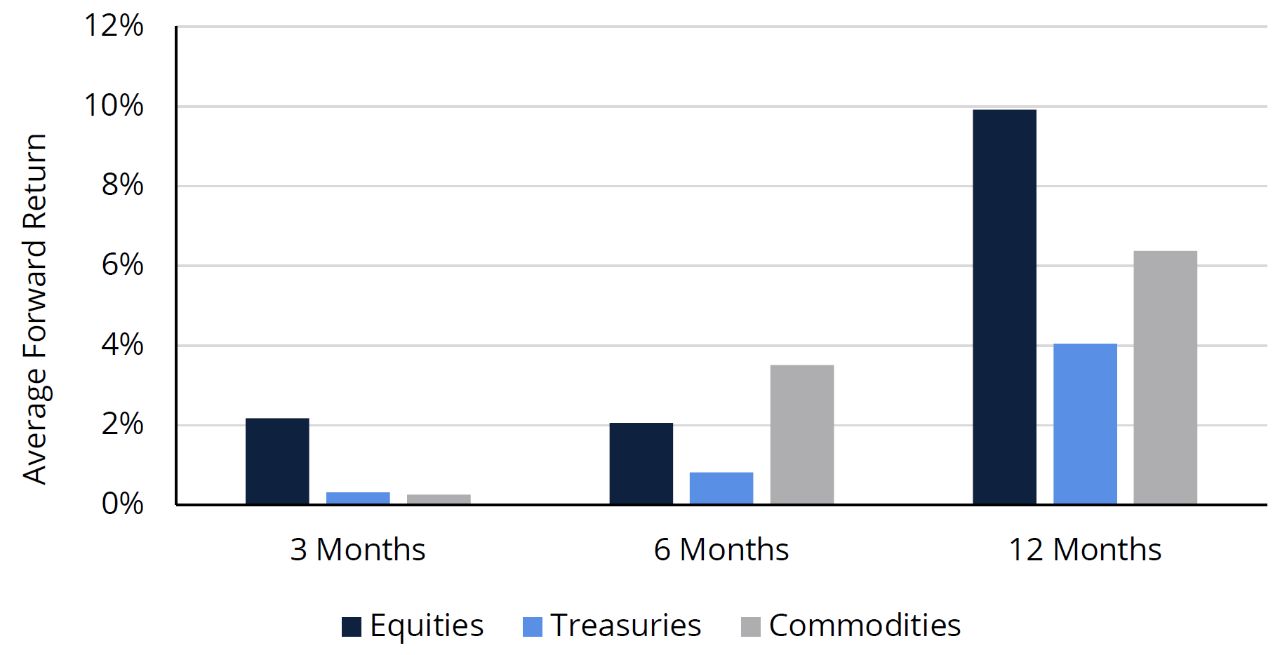
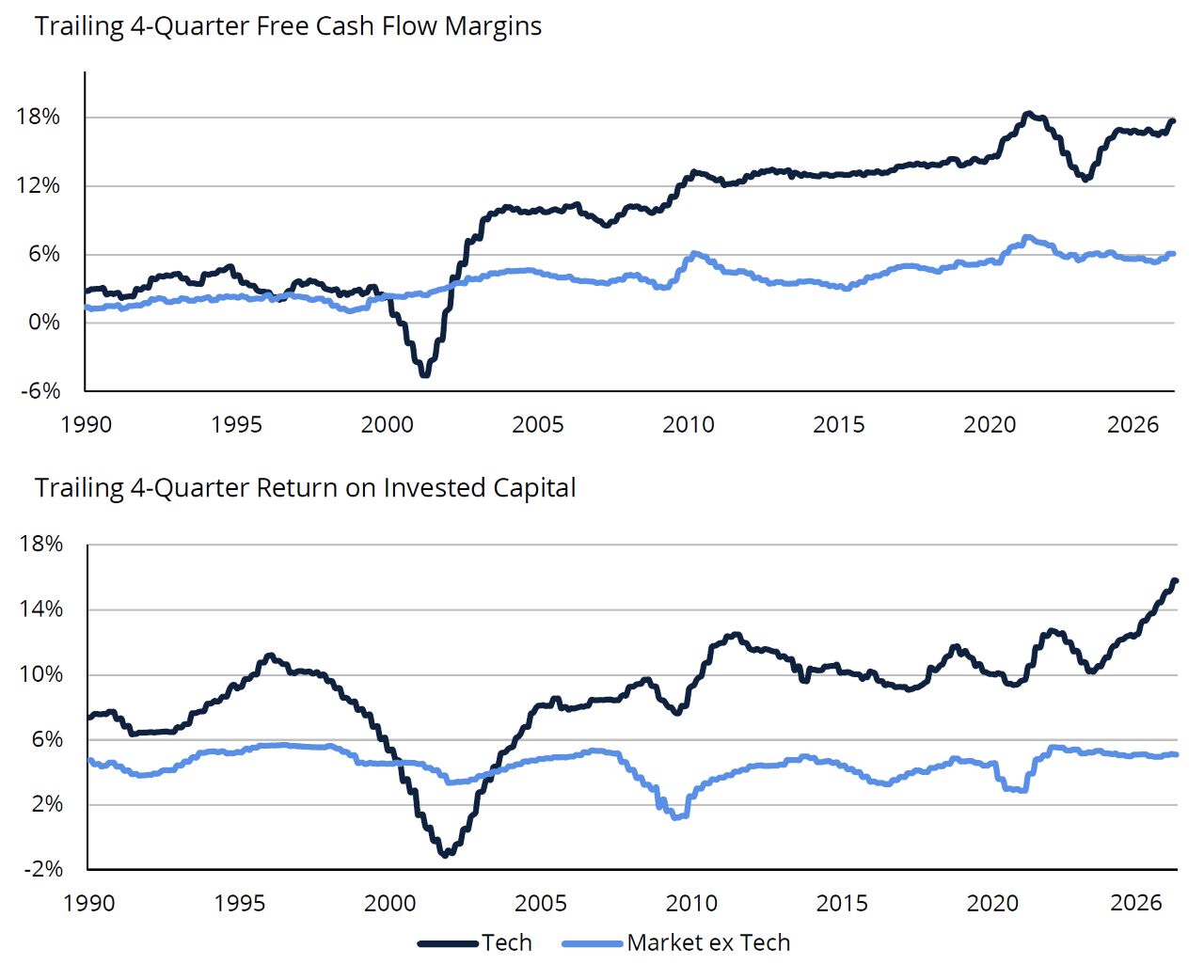
FIGURE 1

Average Returns After 20%+ Oil Shocks: Stagflation
Returns Over 3-, 6-, and 12‑Month Horizons Across Major Asset Classes

Past performance does not guarantee future results. Investors cannot directly invest in indices. Equities are represented by the MSCI World Index; Treasuries by the ICE BofA US Treasury Index; and commodities by the S&P GSCI Commodities Index. Stagflation regime defined as episodes in which US Consumer Price Index rises and real GDP growth weakens over the 12 months following a ≥20% monthly Brent oil price shock. Real GDP measures the value of goods and services produced in the economy, adjusted for inflation to reflect underlying economic growth. Bars show average forward total returns at 3, 6, and 12 months. Please see below for index definitions. For illustrative purposes only. Data Sources: Wellington Management and Refinitiv.


Turning to fixed income, we maintain a moderately overweight view on global government bonds. We think the rapid central-bank pivot from easing to tightening is overdone in some regions, given the potential for high energy prices to drive demand destruction and weaker growth, or for a rapid de‑escalation in the war. Either outcome would shift the narrative away from rate hikes and benefit long‑duration2 exposure.

Japan is the one market in which we maintain a moderate duration underweight. In our view, the market is underpricing both inflation and real‑rate risks.3 Higher energy prices are reinforcing increasingly structural inflation pressures amid tight labor markets and a weak yen, while Japanese government bonds have seen far less repricing than peers. With policy hikes delayed and fiscal support turning more proactive, risks are skewed toward higher yields via rising inflation and term premia.4

Finally, we raised our view on gold to a slight overweight. We were encouraged by the roughly 20% pullback from recent peak prices, more neutral technicals, and our confidence in a continued positive secular trend linked to expectations for a weaker US dollar (USD) and an ongoing bias among central banks and investors to diversify away from the dollar.


Equities: Finding The Right Balance in a Volatile Market

We began 2026 with expectations of double-digit earnings growth, a broadening economic recovery, and limited valuation downside given central banks were easing or on hold. Then came the war in the Middle East. We see some risk that markets aren’t fully pricing in the possibility of a more prolonged conflict and its economic spillover effects. However, global markets entered this crisis with a healthy earnings buffer, unlike the earnings weakness heading into last year’s tariff shock. A de-escalation in the conflict also remains a plausible outcome. On balance, our assessment of the potential outcomes leaves us with a small overweight view on equities over a 12-month horizon.

The durability of the broadening earnings picture that emerged last year will depend on whether input costs rise meaningfully as a result of the energy shock, and whether cyclicals face material demand headwinds if the cycle comes under pressure. That said, we expect earnings to remain a modest tailwind, particularly for the US and EMs. While higher energy costs will pressure margins in some sectors, we continue to expect a positive earnings trajectory in both regions. In the US, the AI innovation theme remains intact (FIGURE 2), despite some supply‑chain risks, such as a potential helium shortage. In EMs, Asia plays a critical role in AI infrastructure through semiconductors and memory.


FIGURE 2

Stellar Tech Margins and Return on Invested Capital

Chart Data: 1/90-2/26. Past performance does not guarantee future results. This analysis covers all US-listed technology stocks and compares them with the broader market excluding technology. The financials sector is also excluded, as free cash flow is generally not an applicable metric for the sector. Free cash flow represents the cash a company can generate after accounting for capital expenditures needed to maintain or maximize its asset base. For illustrative purposes only. Data Sources: Goldman Sachs and Corporate Reports.

A fair amount of valuation adjustment has occurred, but not a full capitulation.

As we’ve seen in prior shocks, markets tend to front‑load valuation repricing before meaningful earnings downgrades come through. Through the end of March, the decline in the 12‑month forward price/earnings (P/E)5 for global equities has been similar in magnitude to the adjustment following Liberation Day. While there may be earnings downgrades to come, the degree of price adjustment is broadly in line with the historical average for conflicts, though not at the extremes seen during major energy shocks such as the Ukraine war in 2022 or the Iraq war in 1990. From a sentiment and positioning perspective, a fair amount of adjustment has occurred, but not a full capitulation.

Again, we’re balancing out these competing elements to arrive at our slight equity overweight. Given conflict‑related volatility, we would need to see either a further downside adjustment or clear upside catalysts tied to a resolution of the conflict before moving to a stronger overweight stance.

On a regional basis, we hold an overweight view on EMs relative to the UK. Overall, visibility into AI‑driven demand remains strong through 2027, and as noted, EMs in Asia play a critical role in the AI supply chain. China’s resilience during the conflict also stands out so far. The country’s energy stockpiles and diversified energy sources have provided support, and policy levers remain available to help smooth any negative effects—even as recent activity data has surprised to the upside.

We have moved to a small overweight view on the US relative to eurozone equities. This largely reflects a disconnect between relative earnings fundamentals and relative price performance, with the gap favoring the US in our view. Relative sentiment captured in investment surveys is also more positive on Europe than on the US and may be due for a reversal. Meanwhile, US mega‑cap tech companies have seen a significant adjustment in relative valuations, making them seem attractive again on a P/E basis. Both the UK and Europe ex‑UK face a weak earnings outlook, although the UK’s relatively high exposure to the energy sector provides some offset.


Fixed Income: Global Bond Yields Just Got More Interesting

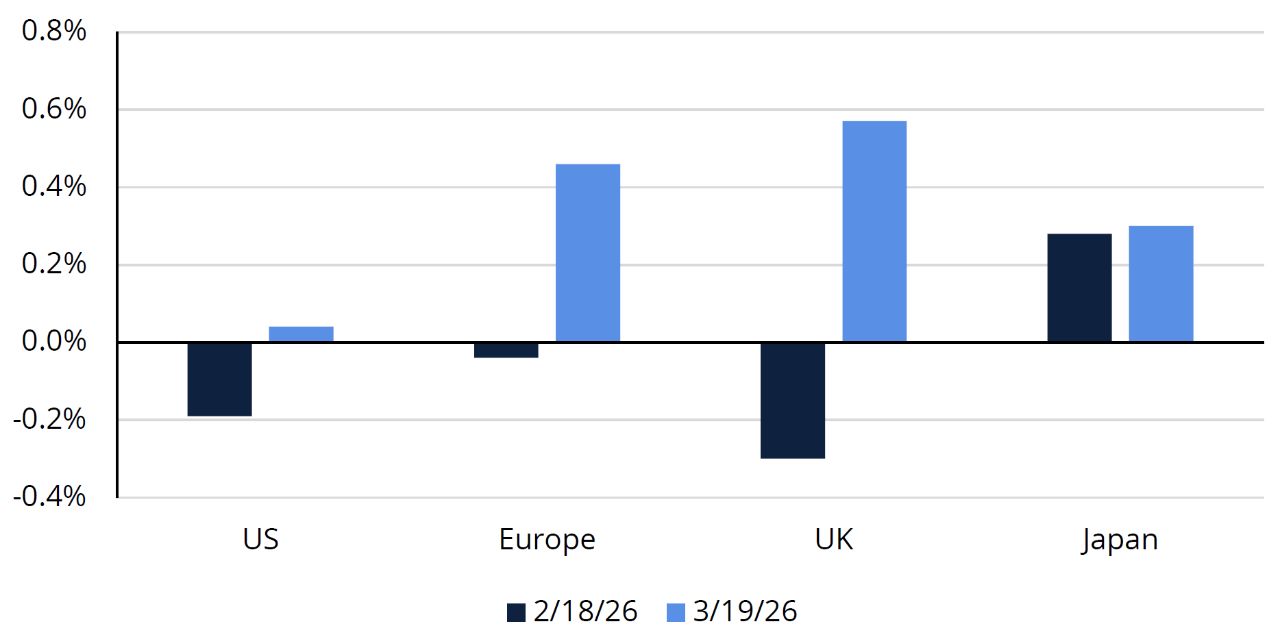
Global government bond yields spiked as the conflict in Iran escalated and markets reassessed the inflation risks associated with a prolonged energy supply shock. Central banks across regions adopted a more hawkish tone, and policy expectations flipped from easing to tightening, driving short‑term yields higher by roughly 10-60 basis points6 (FIGURE 3).


FIGURE 3

Spike in Policy-Rate Expectations
12-Month Forward Policy Expectations vs. Current Policy Rate (%)

Chart Data: 2/18/26-3/19/26. Overnight Index Swap captures market expectations for future overnight interest rates and are often used as a benchmark for policy‑rate pricing. For illustrative purposes only. Data Sources: Wellington Management and Refinitiv.

We see several important differences between today and the 2022 energy shock that could help contain inflation.

Our Multi-Asset Views

Asset Class View Change
Global Equities Moderately OW
DM Government Bonds Moderately OW
Credit Spreads Moderately OW
uparrow
Commodities Moderately OW
uparrow
Cash Moderately UW
uparrow
Within Asset Classes  
Global Equities  
US Moderately OW
Europe ex-UK Moderately UW
UK Underweight downarrow
Asian DMs Neutral
downarrow
EMs Overweight uparrow
DM Government Bonds
US Government Neutral
Eurozone Government Neutral uparrow
UK Government Neutral
downarrow
Japan Government Moderately UW
Credit Spreads
Global IG Credit Moderately OW
uparrow
Global High Yield Moderately OW
uparrow
EM debt Neutral

OW = overweight, UW = underweight

Views have a 6–12-month horizon and are those of the authors and Wellington’s Investment Strategy Team. Views are as of 3/31/26, are based on available information, and are subject to change without notice. Individual portfolio management teams may hold different views and may make different investment decisions for different clients. This is not to be construed as investment advice or a recommendation to buy or sell any specific security.

We’ve maintained our long‑duration stance, supported by more attractive carry7 and two potential states of the world that could lead to lower yields. In one scenario, persistently high energy prices spill over into higher prices for a range of goods, leading to demand destruction and slower growth expectations. In the other, a de‑escalation in the conflict reduces inflation expectations and lessens the need for more hawkish central bank reaction functions.

When considering possible inflation outcomes, some have drawn comparisons between the current energy supply shock and the 2022 shock driven by the war in Ukraine. However, we see several important differences that could help contain inflation today. First, governments have less fiscal flexibility to provide stimulus than they did in 2022. Second, policy rates in some regions (US, UK) were already in mildly restrictive territory. Third, labor markets aren’t as tight as they were in 2022.

As noted, we maintain an underweight view on Japanese government bonds, given that inflation and fiscal risks are meaningful, but both central-bank reactions and inflation and real yields have moved less than in other regions.

As for credit, we remain focused on quality. Spreads8 widened modestly in March in response to conflict‑induced volatility and simmering concerns around private credit. Markets are also absorbing increased supply from AI‑driven hyperscaler issuance and merger and acquisition financing. To take advantage of wider spreads while remaining alert to potential spillover risks from the private-credit space, we favor European credit, including both investment‑grade and high‑yield bonds.

Credit fundamentals are healthier in Europe than in the US, particularly around debt service and leverage. The market is also more heavily weighted toward asset‑intensive sectors rather than software‑ and AI‑related leveraged borrowers. In addition, while US banks aren’t typically direct lenders to middle‑market borrowers, they do lend to private-credit funds and vehicles—a relationship that applies less to European banks.


Commodities: Rethinking Our Views on Oil and Gold

Prior to the war, we held a modest underweight view on oil. However, the onset of hostilities and the resulting surge in oil prices led to a considerable widening in the range of possible outcomes for the asset class, with risks skewed toward the higher end. This heightened uncertainty, combined with the exceedingly high costs associated with rolling positions at the front end of the curve, rendered the risk‑reward profile of our underweight view untenable, prompting a shift to a neutral view.

Meanwhile, we used the recent sell‑off in gold to introduce a slight overweight view. While some long positioning in gold has been cleared out since the war began, leaving it to behave more like a risk asset,9 we believe the fundamental case remains intact. That includes strong long‑term demand potential and gold’s role in diversifying away from the USD.

The biggest risk to our long‑term bullish thesis for gold is the possibility that central banks become net sellers to meet capital needs related to the war. This tempers our conviction and keeps us from moving to a larger overweight, despite the potential for meaningful excess returns relative to cash. Importantly, we would push back against the notion that gold is a reliable inflation hedge, as correlations have been weak or nonexistent. Instead, the primary long‑term relationships are negative correlations with the USD and real yields. While we don’t see significant upside developing in either, a renewed fundamental bull case for the dollar is an additional risk.

Our Multi-Asset Views

Asset Class View Change
Global Equities Moderately OW
DM Government Bonds Moderately OW
Credit Spreads Moderately OW
uparrow
Commodities Moderately OW
uparrow
Cash Moderately UW
uparrow
Within Asset Classes  
Global Equities  
US Moderately OW
Europe ex-UK Moderately UW
UK Underweight downarrow
Asian DMs Neutral
downarrow
EMs Overweight uparrow
DM Government Bonds
US Government Neutral
Eurozone Government Neutral uparrow
UK Government Neutral
downarrow
Japan Government Moderately UW
Credit Spreads
Global IG Credit Moderately OW
uparrow
Global High Yield Moderately OW
uparrow
EM debt Neutral

OW = overweight, UW = underweight

Views have a 6–12-month horizon and are those of the authors and Wellington’s Investment Strategy Team. Views are as of 3/31/26, are based on available information, and are subject to change without notice. Individual portfolio management teams may hold different views and may make different investment decisions for different clients. This is not to be construed as investment advice or a recommendation to buy or sell any specific security.

Investment Implications

Here are four things investors may want to consider:

  • Focusing on the long term — Uncertainty around the economic and market impact of energy-supply disruptions warrants a reset of short‑term expectations. That said, taking our longer‑term views into account, we continue to favor a moderate overweight to global equities, along with opportunistic positioning in other assets that have repriced and remain aligned with portfolio objectives.
  • Earnings are still a tailwind for the US and EMs — While higher costs stemming from rising energy prices will weigh on earnings in some areas, we continue to see a positive trajectory for earnings in both the US and EMs. In the US, the AI innovation theme remains intact. In EMs, Asia serves as a critical backbone for AI infrastructure through semiconductors and memory.
  • Potential spikes in yields — Central-bank expectations have shifted from easing to tightening amid higher oil prices and potential spillovers to other sectors. This move has pushed global yields to more attractive valuations, with the repricing looking overdone in our view. 
  • Focusing on quality in credit — Credit spreads have widened, yet concerns around private credit, AI capital-expenditure‑driven10 supply, and risk assets, in general, persist. We find European credit to have better fundamentals than the US, particularly in terms of debt service and leverage, and it’s more insulated from US private-credit issues.

Talk to your financial professional about how to position your portfolio amid a changing economic landscape. 


1 Stagflation is an economic cycle characterized by slow growth, inflation, and signs of labor market weakness.

2 Duration is a measure of the sensitivity of an investment’s price to nominal interest-rate movement.

3 Real‑rate risk is the risk that inflation remains elevated while policy stays looser than expected, pushing inflation‑adjusted yields higher and weighing on bond valuations.

4 The term premium is the amount by which the yield on a long-term bond is greater than the yield on shorter-term bonds. This premium reflects the amount investors expect to be compensated for lending for longer periods.

5 The price-to-earnings ratio measures a company’s share price relative to its earnings-per-share and helps assess the relative value of a company’s stock.

6 A basis point is a unit that is equal to 1/100th of 1% and is used to denote the change in a financial instrument. The basis point is commonly used for calculating changes in interest rates, equity indexes and the yield of a fixed-income security.

7 Carry is the difference between the yield on a longer-maturity bond and the cost of borrowing.

8 Spreads are the difference in yields between two fixed-income securities with the same maturity but originating from different investment sectors.

9 Risk assets refers to assets that have a significant degree of price volatility, such as equities, commodities, high-yield bonds, real estate, and currencies.

10 Capital expenditures are the money a company spends to buy or upgrade long-term assets such as buildings or equipment.

The Consumer Price Index is a measure of change in consumer prices as determined by the US Bureau of Labor Statistics.

ICE BofA US Treasury Index tracks the performance of US dollar–denominated US Treasury securities across the yield curve, reflecting interest rate movements in the government bond market.

MSCI World Index is a free float-adjusted market capitalization weighted index that is designed to measure the equity market performance of developed markets.

S&P GSCI Commodity Index consists of 24 commodity futures on physical commodities across five sectors: energy, agriculture, livestock, industrial metals, and precious metals.

Important Risks: Investing involves risk, including the possible loss of principal. • Foreign investments may be more volatile and less liquid than U.S. investments and are subject to the risk of currency fluctuations and adverse political, economic and regulatory developments. These risks may be greater, and include additional risks, for investments in emerging markets or if focused in a particular geographic region or country. • Fixed income security risks include credit, liquidity, call, duration, and interest-rate risk. As interest rates rise, bond prices generally fall. • Investments in high-yield (“junk”) bonds involve greater risk of price volatility, illiquidity, and default than higher-rated debt securities. • Investments in the commodities market may increase liquidity risk, volatility and risk of loss if adverse developments occur. • Investments in the technology sectors may go in and out of favor, which may cause underperformance.

The views expressed here are those of the authors and are based on available information and are subject to change without notice. This information should not be considered as investment advice or a recommendation to buy/sell any security. In addition, it does not take into account the specific investment objectives, tax and financial condition of any specific person. Portfolio positioning is at the discretion of the individual portfolio management teams; individual portfolio management teams and different fund sub-advisers may hold different views and may make different investment decisions for different clients or portfolios. This material and/or its contents are current as of the time of writing and may not be reproduced or distributed in whole or in part, for any purpose, without the express written consent of Wellington Management or Hartford Funds.

MFGS_041326 5374087

Insight from sub-adviser Wellington Management
Nanette Abuhoff Jacobson Headshot
Managing Director and Multi-Asset Strategist at Wellington Management Company and Global Investment Strategist for Hartford Funds

Nanette Abuhoff Jacobson consults with clients on strategic asset allocation issues and works with investment teams throughout Wellington to develop relevant investment solutions across asset classes.

Author Headshot
Managing Director and Multi-Asset Strategist – EMEA at Wellington Management